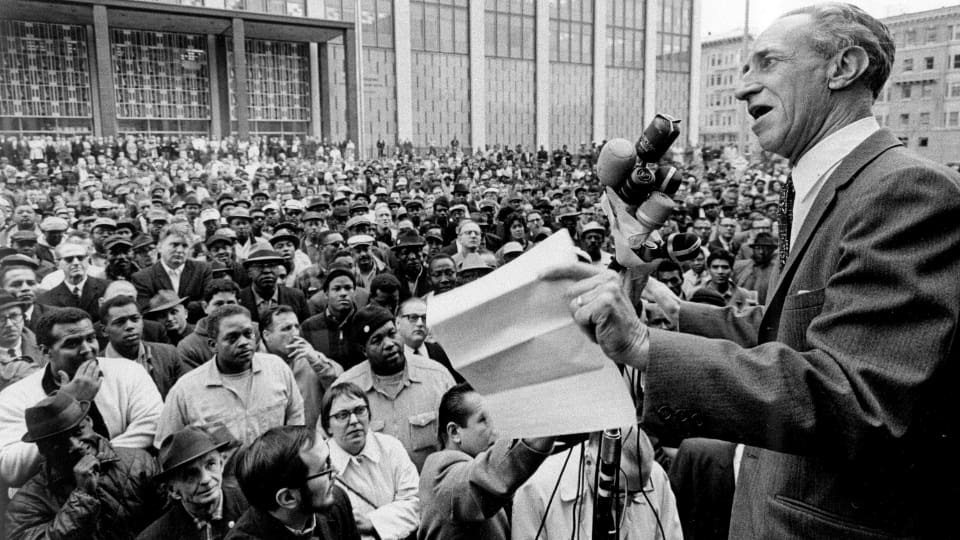
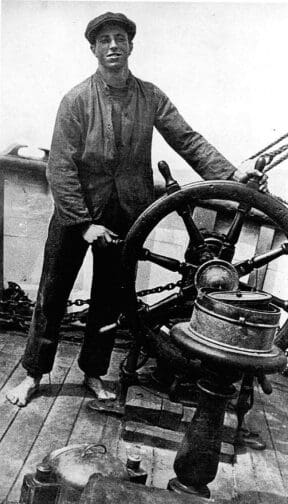
The International Longshore and Warehouse Union (ILWU) is a storied labor union, deeply entwined with the history of labor movements on the West Coast of the United States. Its origins trace back to 1937, a time when longshore workers and warehouse employees faced grueling conditions, extremely dangerous job sites, meager wages, and exploitative labor practices that treated longshoremen as expendable and disposable.

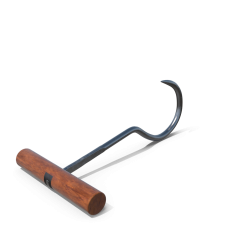
In those days, longshoremen relied on a simple yet crucial tool known as the "T Hook" or "hay hook." This tool, essentially a long-handled, curved hook with a T-shaped handle, was vital in manually stowing cargo in the holds of ships. Longshoremen used these hooks to secure and position heavy and unwieldy loads within the vessels such as cow hides or ice blocks, often in challenging conditions.

The "T Hook" became an enduring symbol of the resilience and determination of longshore workers during this era. It represented not only the physical demands of their work but also the inherent solidarity of dockworkers.

Established as a response to these harsh conditions, the ILWU swiftly gained prominence under the leadership of notable figures such as Harry Bridges. One of the most pivotal moments in its history occurred during the 1934 West Coast waterfront strike, a defining chapter that saw the loss of two men's lives during altercations with San Fransisco riot police on July 5, 1934. This day is known as "Bloody Thursday"; a day commemorated every fifth of July by ILWU members along the West Coast.

Throughout its evolution, the ILWU has upheld the motto "An Injury To One Is An Injury To All." This rallying cry underscores the spirit of solidarity among its members.

Over the decades, the ILWU expanded its influence, encompassing various sectors, including agriculture, fishing, and warehousing. The union also took up the mantle of advocating for civil rights, with Harry Bridges and the ILWU actively promoting equality for all workers, regardless of their racial or ethnic backgrounds.

Today, the ILWU remains a formidable presence in the labor movement, representing workers along the West Coast of the United States, Hawaii, Alaska, and Canada. An unwavering commitment to solidarity and the pursuit of fair labor practices marks its history. The "hay hook," once a symbol of both the toil and skill of longshoremen, has now transformed into an iconic emblem of the enduring longshore spirit and has itself become better known as the "Longshore Hook".

As the ILWU journeyed through the decades, it carried with it the legacy of those who came before, who labored tirelessly with their longshore hooks in hand. The challenges they faced, the sacrifices they made, and the solidarity they displayed continue to shape the identity of the ILWU and its members today.

In an ever-evolving world, the ILWU stands as a testament to the power of collective action, the importance of fair labor practices, and the enduring symbol of the longshoremen, reminding us of the tenacity and strength of those who have shaped this union. The ILWU's commitment to equality and the welfare of its members remains as resolute as ever.
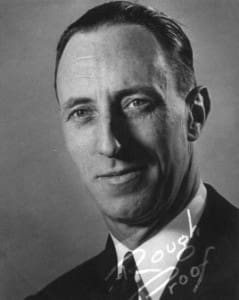
Harry Bridges: A Labor Icon and the Founding of the ILWU

Harry Bridges, an influential figure in the American labor movement, is celebrated for his steadfast dedication to the rights and well-being of dockworkers and warehouse laborers on the West Coast. His life and career were characterized by persistent labor advocacy and played a pivotal role in the formation and growth of the International Longshore and Warehouse Union (ILWU). Bridges' story is not only one of relentless labor activism but also one of enduring multiple prosecutions and false accusations by the U.S. government, falsely labeling him as a Communist.

Early Life and Arrival in the United States:

Born on July 28, 1901, in Kensington, Melbourne, Australia, Harry Bridges embarked on a journey that would ultimately reshape the labor landscape in the United States. In his youth, he worked in various jobs, including as a seaman, which led him to cross the Pacific and settle in San Francisco, California, in 1920.

Formation of ILA Local 38-79:

By the 1930s, the working conditions for waterfront laborers along the West Coast were deplorable, marked by meager wages, job insecurity, and harsh treatment. Bridges, inspired by the burgeoning labor movements across the country, became deeply involved in the struggle for workers' rights. He played a central role in organizing the longshoremen and warehouse workers in San Francisco and beyond.

In 1933, Bridges and other dedicated activists established the International Longshoremen's Association (ILA) Local 38-79. This local union sought to represent the diverse workforce of dockworkers, many of whom were immigrants, responsible for loading and unloading cargo on the bustling waterfront. Under Bridges' leadership, Local 38-79 rapidly expanded its membership and influence.

1934 Maritime Strike and the Birth of the ILWU:

The watershed moment in Harry Bridges' career arrived with the 1934 West Coast maritime strike. This historic strike, originating in San Francisco and cascading along the coast, emerged as a massive and at times violent confrontation between waterfront laborers and the powerful shipping companies. Bridges emerged as a prominent leader of the strike, galvanizing workers and coordinating their efforts.

During the strike, Bridges recognized the need for a more unified and comprehensive approach to organizing and representing maritime workers. In response, he played a pivotal role in founding the International Longshoremen's and Warehousemen's Union (ILWU) in 1937. The ILWU aimed to bring together longshoremen, warehouse workers, and other related labor groups under one banner to enhance their working conditions, secure better wages, and fortify job security.

False Accusations of Communism:

Harry Bridges' dedicated labor activism and his influential role within the ILWU made him a target for the U.S. government during the Red Scare era, characterized by intense scrutiny of alleged Communist ties. Authorities repeatedly accused Bridges of harboring Communist sympathies and sought to have him deported. These allegations were part of a broader anti-Communist sentiment in the United States, leading to the infamous McCarthy era.

Between 1939 and 1955, Bridges endured four separate deportation trials. However, despite the government's relentless efforts to prove his alleged Communist affiliations, Bridges was never successfully deported. Throughout these trials, he consistently maintained his innocence, emphasizing that his primary concern was the well-being of workers and their rights. His steadfast assertion that he was not a Communist was corroborated by various investigations and testimonies.

Enduring Contributions and Legacy:

Harry Bridges' leadership within the ILWU continued for decades, and his legacy is marked by significant achievements for union members, including improved wages, enhanced working conditions, and fortified job security. Bridges remained committed to workers' rights until his retirement in 1977.

Beyond his labor leadership, Harry Bridges became an iconic figure in the American labor movement, celebrated for his unwavering determination and dedication to the well-being of working people. His profound contributions to the ILWU and the broader labor movement continue to be remembered and honored.

Harry Bridges passed away on March 30, 1990, leaving behind a remarkable legacy of labor activism that continues to inspire and shape the labor movement in the United States.

* These videos are not official ILWU productions and the ILWU or its affiliates are not associated with the accounts, publishers, or channels of these videos.

- Oregon Public Broadcasting via YouTube

- Port of Los Angeles via YouTube

2011

EGT Struggle

ILWU Local 21 had a prolonged struggle against EGT Development in Longview, Washington, over the use of ILWU labor for grain exports.
2000's

Challenges in the New Millennium

The ILWU continued to face challenges in the new millennium, including disputes over automation and efforts to protect workers' rights and livelihoods.
1996

1996 Pacific Coast Longshore Contract

The 1996 contract clarified and secured ILWU jurisdiction over on-dock intermodal rail yards, intra-port drayage of containers, container maintenance and repair, and vessel planning. It eliminated employers' "side deals" with individual operators that divided the workforce.
1993

Peavey Battle

The ILWU fought Peavey, a ConAgra subsidiary, over illegal grain-soaking practices and proposed cuts in manning levels. The union gained community and international support, forcing Peavey to compromise on its contract proposals and pay fines for grain-soaking.
1988-1992

USS-POSCO Dispute

The ILWU worked with labor and environmental groups to hold USS-POSCO accountable for anti-union policies and environmental concerns. An agreement was reached in 1992, protecting the ILWU's jurisdiction and imposing fines for environmental violations.
1987-1989

Defense of Longshore Jurisdiction

ILWU members in the Northwest defended longshore jurisdiction against ITT-Rayonnier's attempts to use non-union operations for log exports. Protests and demonstrations eventually ensured ILWU labor for future operations. The ILWU successfully intervened against Canadian shipowners who tried to use their crew members to operate cranes during log-loading operations in U.S. ports in 1989.
1971

1971 Strike

After a 134-day strike, members accepted a new agreement by a 71 percent "yes" vote. The settlement included improved language on container jurisdiction, new dental benefits, paid no-work holidays, and a "Pay Guarantee Plan" for registered longshoremen whose work opportunities declined due to mechanization. The settlement terms marked the beginning of a transformation in longshore work, particularly in Southern California, with the spread of "steady" equipment operators who rarely used the union hall for job assignments. The ILWU faced challenges due to technological innovations and international economic integration. Containerization allowed employers to bypass struck ports by offloading cargo in Canada and Mexico, but increased solidarity among workers helped offset this advantage. The ILWU launched organizing campaigns to bring unorganized waterfront workers into the union. This included office clerical workers, workers at new intermodal rail yards, and mechanics involved in container and cargo-handling equipment maintenance and repair. Employers often resisted unionization and sought to bypass or curtail traditional ILWU jurisdiction on the waterfront. The ILWU mobilized to defend its jurisdiction and the right to organize in the face of technological change and anti-labor sentiments.
1971

Containerization Dispute

Contract negotiations in 1971 centered on the consequences of containerization. The resulting strike, with a 96.4 percent "yes" vote, became the longest coastwise longshore strike in U.S. history. In San Francisco's Local 10, the central issue was whether employers could redefine work rules and job categories to create a new class of workers for container operations, known as "steady men." During this period, the ILWU faced challenges related to technological changes and the preservation of workers' rights and job security in a rapidly evolving industry.
1960

The 1960 Contract

A historic Modernization and Mechanization Agreement (M&M) was ratified in 1960. Rising construction costs, fuel prices, wharfage fees, and seafaring wages pushed the shipping industry to increase productivity and turnaround time for vessels. The ILWU realized that change was inevitable, with new methods and machines being introduced. The union aimed to retain old rules governing work practices as long as possible. The union and employers agreed on principles for the 1960 contract, including freedom for employers to introduce labor-saving devices and the elimination of unnecessary workers in exchange for benefits for the workers. Workers were guaranteed job security, protection against layoffs, and a share of increased profits in the form of higher wages and benefits. Labor-saving devices were to be introduced to ease hard and hazardous work.
Late 1950's

New Agreement

In the late 1950s, technological changes in the shipping industry led to debates among workers regarding the introduction of machinery.
1958

Hawaiian Labor Movement

The ILWU played a pivotal role in the Hawaiian labor movement, including the 1958 strike by sugar and pineapple workers.
Early-Mid 50's

Technological Challenges

Advances in technology presented challenges to longshore workers, necessitating negotiations for new work rules.
1950-1957

Prosecutions and McCarthy Era

Harry Bridges faced multiple prosecutions and accusations by the United States government, falsely accusing him of being a Communist. Despite these challenges, Bridges continued to lead the ILWU.
1947

Taft-Hartley Law

In 1947, Taft-Hartley Act was passed, outlawing certain union practices, eroding strike rights, and requiring leaders to declare non-communist affiliation. Employers demanded the ILWU give up the hiring hall. The NLRB tried to force a vote on employers' offers. The ILWU recommended rank-and-file boycott the NLRB poll. Every eligible worker boycotted, demonstrating immense union strength and solidarity. Employers focused on "Communist leadership" as the main issue. The union remained united, and the strike began on September 2. Leadership changes were demanded, but workers stood by their leaders. The shipowners eventually reorganized and returned to the bargaining table. Shipowners announced a new approach, leading to progress in negotiations and ending the strike.
1946

Post-WWII Challenge

After World War II, employers sought to roll back labor gains, leading to the formation of the Committee for Maritime Unity (CMU) in 1946. The CMU negotiated for workers' rights, but President Truman threatened to use the military to break the strike. International support poured in. The CMU, with Harry Bridges as spokesman, secured improved wages, benefits, and preserved the union hiring hall.
1945

Expansion to Hawaii

ILWU Local 142 was established in Hawaii, representing longshore and warehouse workers.
1943

Expansion to Alaska

ILWU Local 37 was chartered in Alaska, representing longshore workers in Anchorage and Fairbanks.
1938-48

Spread of Rank-and-File Unionism

ILWU's rank-and-file unionism under the CIO banner expanded across various industries from 1938 to 1948.
1938

San Francisco Bay Area Warehouse Strike

Warehouse employers in the San Francisco Bay Area locked out workers who refused to handle cargo loaded by strikebreakers. The strike ended with significant gains for workers.
1937

CIO Affiliation

In 1937, the ILWU officially formed after disaffiliating from the ILA and affiliating with the CIO. Not all locals were immediately disaffiliated from the ILA. Some, like Tacoma's Local 23, remained with the ILA and AFL for years, joining ILWU in 1958. Grainliners' Local 1892 near Longview, Washington, joined ILWU's Local 21 in 1981, marking the end of ILA presence on the Pacific Coast.
1936

The March Inland

Employers sought to challenge unions but did so without violence. Gains were made for seamen, which the longshoremen had won in 1934. The ILWU's success was attributed to solidarity and democracy, with members controlling all aspects of the union. The ILWU championed industrial unionism, uniting all industry workers, in contrast to craft unionism. The ILWU expanded its efforts to organize warehouse workers and distribution center laborers. This "march inland" aimed to improve conditions for workers beyond the docks.
July 9, 1934

A Solemn Procession

On July 9th, 1934, a grand and solemn funeral procession took shape, honoring the fallen longshoremen Sperry and Bordoise. This majestic procession made its way up the iconic Market Street in San Francisco. According to Henry Schmidt, an esteemed figure in the early longshore workers' movement, an astonishing crowd of 50,000 spectators gathered along the street to witness this poignant event. This remarkable day marked a significant turning point in public sentiment, with overwhelming support shifting in favor of the striking longshore workers. The tragic loss of these two workers seemed to awaken the collective conscience of the community. The profound change in public opinion that followed the deaths of Sperry and Bordoise likely played a pivotal role in swaying the board responsible for arbitrating the longshore strike. In the end, this shift in support may well explain why the board ultimately acceded to the union's central demands.
July 5, 1934

Bloody Thursday

Violent clashes between strikers and authorities occurred in San Fransisco, California. Two workers were shot and killed, and six workers were killed during the entire strike. The San Francisco labor movement declared a General Strike in support of longshore and maritime unions. Although brief, it garnered widespread public support. International support for strikers highlighted the futility of using scab labor. Minority workers refused to scab. After federal intervention, the union agreed to arbitrate issues and won in principle on major demands. The strike sparked new unions along the Pacific Coast and led to the first multi-employer collective bargaining unit in an entire industry. Unity between longshoremen and seafarers formed the Maritime Federation of the Pacific, strengthening solidarity.
1934

The 1934 Strike

In May 1934, longshore and seafaring unions voted to strike. Employers mobilized to crush unions and picket lines. Strikers faced police violence and resistance from national union leaders, but they held firm.
1933

Economic Depression

The Great Depression hit longshoremen harder, making union organization a survival imperative. Longshoremen formed a single, coastwide, and industry-wide union unit to address their demands. Their demands included a union-controlled hiring hall, coastwide contracts, equalized work opportunities, and a six-hour workday with fair wages. Shipowners consistently rejected these demands, aiming to divide and destroy unions in each port.
Late 1920's - Early 1930's

Shape-Ups and Struggles

Longshore workers faced harsh conditions, discrimination, and unsafe practices. They learned that discrimination weakened their unions.
1922

Harry Bridges Arrives in San Fransisco

Harry Bridges, a seaman from Australia, arrived in San Francisco in 1922. He began working as a longshoreman and became involved in labor-organizing efforts on the waterfront.
1916-1921

Divisions and Strikes

Employers exploited divisions among local unions, using tactics like importing African American strikebreakers and diverting cargo to undermine longshore unions in strikes of 1916, 1919, and 1921. Coordinated efforts by employers and police agencies led to the destruction of genuine unionism among longshore workers on the Pacific Coast for over a decade.
1910

ILA Pacific Coast District

Longshoremen re-affiliate with ILA, led by T.V. O'Connor, who guarantees autonomy for the newly chartered Pacific Coast District of the ILA. The ILA's Pacific Coast District operates with autonomy, allowing local-by-local strike action and settlement.
1909

Loose Federation Formed

Loose federation formed in response to seamen encroaching on longshore work. The federation aims to protect longshore jobs and autonomy.
Early 1900's

First Unions Form

The first West Coast longshore unions form, loosely affiliated with the American Federation of Labor's International Longshoremen's Association (ILA).
1895

Formation of the I.L.A.

The National Longshore Association (NLA), formed a few years earlier, changed its name to the International Longshoremen's Association (ILA). The ILA focused on organizing and representing longshore workers in Eastern and Gulf Coast ports, expanding later to Eastern Canada and Puerto Rico.
19th Century

19th Century

Longshore industry emerged on the Pacific Coast, with workers known as "longshoremen"; an abbreviation of "Men Along the Shore". Brutal working conditions, irregular employment, and low wages prevail. Dockworkers were considered the lowest rung on the economic ladder, with little to no respect for the trade, or the people who worked on the docks.
No content on this website is to be copied or redistributed, including but not limited to photos, videos, other media, or written content.
© 2025 ILWU Local 21. All rights reserved.
Website Admin Privacy Policy Disclaimer Credits

Log In

[ultimatemember form_id="127"]